
He kāinga tupu, he kāinga ora.
A nurtured home, a healthy home.
Module Objectives:
- Describe the roles and responsibilities of the Ministry of Education and Boards of Trustees in the day-to-day management and cyclic maintenance of school property in New Zealand.
- Explain the purpose and key components of the 5 Year Agreement (5YA) and the 10 Year Property Plan (10YPP) in relation to school property funding and planning.
- Analyse how property upgrades can enhance the learning environment within a school setting.
- Evaluate the alignment of their own kura’s current property status and future plans with the challenges and opportunities outlined in Te Rautaki Rawa Kura – The School Property Strategy 2030.
- Reflect on the strategic directions for school property to 2030 and their implications for future property management within their kura.
- Identify key priorities for property development and maintenance based on their school’s context and strategic goals.
Every school in New Zealand provides a physical environment for learning. These environments vary widely in age, size, scale and functionality, reflecting the era in which they were created and the investment made in their maintenance over time. Funding for support of schools is formula driven and roll dependent, factoring in roll numbers as well as such dimensions as ethnicity and socio-economic status.
All schools are supported in maintaining the structure, function and development of their physical environment by partnership between the Ministry of Education, owners of the land and buildings of the school, and the Board of Trustees, who are tenants of the Ministry (Integrated schools have ownership of property).
The following diagrams, extracted from Te Rautaki Rawa Kura – The School Property Strategy 2030, summarise the extent of the property portfolio for Education in New Zealand.
Day to day Property Management
The challenge of property maintenance and management is always to use the funding available to provide the optimal learning environment for students and teachers. This is a balancing act between maintaining existing property and planning for upgrades and innovations. It usually requires engagement with property advisers as well as financial advice and is something that the cyclic funding agreements with the Ministry set out to define and support.
There are two of these cyclic property agreements:
- the 5YA (5 Year Agreement) which is a capital funding budget to use over a 5 year period, helping schools plan for capital upgrades as part of the second cyclic agreement, the 10 Year Property Plan (10YPP) process.
- The 10YPP, 10 Year Property Plan is developed to ensure that the school is well maintained and the physical environment supports teaching and learning, within the budgets provided by the Ministry. The 10YPP sets out the property work to be completed over a 10 year timeframe.
The following information about property management is extracted from the Ministry of Education website and supported by the material found at the Ministry Property portal at https://property.education.govt.nz/:
The Ministry’s Role
The Ministry is responsible for the management of the state school property portfolio of around 2,100 schools. They also provide advice and funding for around 330 state integrated schools in New Zealand.
The Ministry is responsible to the Government for making sure that Boards of Trustees:
- care for school property
- follow Government and Ministry spending rules when using property funding
- spend funding in a way that will get the best educational outcomes for their school.
The Ministry does this by:
- developing policies and procedures so Boards can meet all legal requirements and Ministry standards for school property
- allocating property funding through various funding programmes so Boards can build and maintain school property
- providing information and advice about how to manage school property using the website at https://www.education.govt.nz/school/property-and-transport/roles/state-schools/ as the main resource
- supporting Boards when property at a school is affected by disasters or other problems
- monitoring compliance so they can assure Government that Boards are using the funding well and caring for property at their school.
Boards’ Role and Responsibilities
The Ministry notifies the board of a state school of their responsibilities for managing school property in a Property Occupancy Document (POD). https://web-assets.education.govt.nz/s3fs-public/2024-08/Property-Occupancy-Document-POD-2022.pdf?VersionId=AkDp0tdpPjGF_U6J769ZGU6K6vrmU9jZ#:~:text=The%20POD%20is%20a%20legal,integrated)%20school%20and%20the%20Ministry.
To manage property at a school, the Board must:
- maintain school property
- upgrade and modernise school buildings
- plan for the need for new capital works (new buildings and services) at the school.
The board’s responsibilities are to:
- make sure the school charter outlines how school property will contribute to raising student achievement.
- make sure property work that is commissioned complies with all legal and Ministry requirements. Part of this role is to hire the right people, like project managers and contractors, to do property work Boards should make sure that the people hired meet all legal and Ministry requirements, have an appropriate level of skill for the job, and are working in a healthy and safe environment.
- develop a 10 Year Property Plan (10YPP) to plan for the right amount of space and to care for school property so that the school provides the best learning environment. (Refer to the 10YPP page.)
- manage capital building projects, meeting the Ministry’s project management requirements. (Refer to the Project management page.)
- oversee the school’s day-to-day maintenance to keep it in good order and repair.
Future Planning for Property Management
The day-to-day planning and management of school property falls under the wider umbrella of the future focused School Property Strategy 2030 Te Rautaki Rawa Kura. The School Property Strategy 2030 sets the long term direction for how the Ministry will manage school property to support all schools having quality learning environments by 2030.
It will also provide the framework for any improvements the Ministry makes in their continued effort to support schools to manage school property effectively.
The Strategy is supported by four objectives:
- Quality Learning Environments – school property meets agreed standards to support teachers to succeed
- Sustainable Portfolio – policies, planning and investment optimise long-term social, environmental and economic benefits
- Well-managed Property – everyone understands their role in managing school property and is supported to deliver
- Equitable Outcomes – diversity is recognised, and schools and students with the greatest needs are prioritised.
It also makes four assumptions:
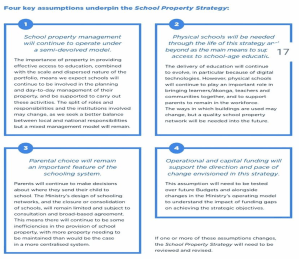
Te Rautaki Rawa Kura 2030 will be regularly reviewed to consider wider changes occurring in the system, specifically maintaining alignment with government’s objectives, and progress made to date in relation to improving asset management.
Pages 23 to 35 of the document outline the implementation plans for the School Property Strategy to 2030 and are the focus if you respond to assignment 5, part (b) but the whole report provides context.
It is also worth noting that a significant Ministerial Inquiry into School Property was conducted in 2024. The findings, released in October 2024, were critical of the Ministry of Education’s management of the school property portfolio, highlighting issues such as:
- Bureaucratic and inefficient processes.
- Lack of transparency in funding decisions.
- Ineffective organizational structure.
- Significant delays and cost overruns in projects.
- Concerns about the value for money of offsite manufactured buildings
See here for more information on the inquiry – https://www.education.govt.nz/our-work/strategies-policies-and-programmes/property-and-infrastructure/independent-inquiry-school-property-system
And here for more on the Government’s response to this. – https://www.beehive.govt.nz/release/school-property-back-track
Task:
Choose to respond to either dimension one or dimension two:
EITHER:
Dimension 1 – Day-to-day Property Management
- From your school’s 10YPP, identify one key priority for implementation in this cycle and, in a brief forum post (max. 150 words), comment on the rationale behind this priority in terms of teaching and learning.
OR
Dimension 2 – Future Planning for Property Management
- Reading through pages 18 to 21 of the Te Rautaki Rawa Kura 2030 document, identify one key area where your current kura is aligned with future directions OR one key area that would need to improve. Briefly explain your choice and its implications in a forum post (max. 150 words).
Accompanying Resource Documents:
Enrolments, School Financials and Facilities
Understanding School Property
POD State Schools
Property Funding and Financials
MOE-Te-Rautaki-Rawa-Kura-The-School-Property-Strategy-2030
Property Projects School and MoE
5 Year Agreement (5YA) Property Funding
10 Year Property Plan
Roles and Responsibilities in Property Management
State School Property Management and POD
Link to all documents: https://drive.google.com/drive/folders/13zbyqV-86hFg9hEC1ZQ_LGpfG2dOOp3m?usp=drive_link
Assessment:
- Completion of relevant readings.
- Participation in the online forum discussion.
- Post on forum
6 Responses
One key priority identified in our current 10YPP is investigating and repairing drainage issues across the school site. This work has been prioritised because flooding has been an ongoing concern and affects the functionality and safety of the school environment. From a teaching and learning perspective, reliable drainage is important because poor site conditions can disrupt access to learning spaces, limit the use of outdoor areas and create safety concerns for both ākonga and staff. Addressing the issue helps ensure the school remains safe, dry and functional throughout the year. This has reinforced for me that property planning is not separate from teaching and learning. Even infrastructure projects that may appear operational have a direct impact on the quality, continuity and accessibility of the learning environment. Effective property management therefore supports both student wellbeing and successful learning.
Dimension 1 – One key priority in Leamington School’s current 10YPP is the refurbishment of our Block B classrooms. While the project includes replacing ageing flooring and improving thermal comfort, the bigger opportunity is creating learning spaces that better support the way we teach today. As we continue to strengthen our Structured Literacy and Mathematics programmes, it is important that our classrooms allow for flexible grouping, collaboration and purposeful learning. Well-designed learning environments can improve student engagement, minimise distractions, and give teachers greater flexibility to meet the diverse needs of learners. For me, this project is about much more than upgrading buildings. It is about investing in spaces that support high-quality teaching and learning, while aligning with Te Rautaki Rawa Kura 2030’s vision of providing quality learning environments that enable both teachers and students to succeed.
Dimension 1 – Day-to-day Property Management:
From your school’s 10YPP, identify one key priority for implementation in this cycle and, in a brief forum post (max. 150 words), comment on the rationale behind this priority in terms of teaching and learning.
A key remediation project in our 10YRPP for 2026/2027 is the renewal of our school bus bay, footpaths & asphalt courts – all considered ‘essential infrastructure’ due to their functionality, as well as health & safety regulations. This project is designed to address identified functionality issues so that ALL students & teachers, including those with mobility issues, can access and move around the school without impairment. In addition to keeping people and the property safe & secure, during school hours and after hours. Although the asphalt courts were ‘dressed over’ (only a couple of years ago) with interlocking modular sport tiles, these have proven to be ‘not-fit-for-purpose’ and therefore dangerous due to the old, uneven asphalt surface lurking underneath, as well as the toughened plastic tiles being extremely slippery & ‘grater-like’ when children are playing on them. Because our two courts are a key component of our school, used multiple times per day for learning & play, this project will be funded out of our MOE allocation, with initiation starting in November 2026, followed by construction in February 2027.
Dimension 1 – Day-to-day Property ManagementA key priority in our school’s current 10YPP is the reroofing of our Year 3 block. The existing roof is at the end of its life and in poor condition, with significant wear and structural vulnerability that impacts the overall quality of the learning environment.
Because our school footprint is so compact, we really can’t afford to lose any classroom space to leaks or dampness. Dealing with stained ceiling tiles and sudden room shuffles would add a lot of unnecessary cognitive load for our teachers and students. By locking in a dry, dependable space, we keep things calm and steady, as well as improving the aesthetics of the school. This means our teachers can focus 100% on teaching and learning without any unnecessary distractions.
Dimension 1: 10 YPP one key priority.
A key priority in our school’s current 10YPP is the replacement of the end-of-life carpets in Rooms 1–4. The existing carpets are in poor condition, with significant wear and damage that impacts the overall quality of the learning environment. They look and feel shabby!
While carpet replacement may appear to be a maintenance project, it has important implications for teaching and learning. Well-maintained classrooms contribute to a welcoming, safe, and comfortable environment where students feel a sense of pride and belonging. New carpet tiles will improve the appearance and functionality of the learning spaces, reduce trip hazards, and support effective classroom management. They will also provide a more durable and practical flooring solution for high-use learning areas, and match the tiles now being used in many other spaces such as the office and staffroom. This investment aligns with our strategic goal of providing engaging, high-quality learning environments that support student wellbeing, learning, and achievement.
Dimension 2 – Future Planning for Property Management
Aignment with Furture Directions: Improving and better maintaining property
condition could reduce long-term liabilities.
Our kura consists of 2 very old, large buildings. One has a brick exterior the other is wooden. The continued upkeep of the wooden exterior is an ongoing challenge. Working closely with the Ministry to access suitable funding for maintaining a building of this nature (particularly in a harsh climate) has been integral to being able to support economic outcomes. Engaging with the MOE property team and making them aware of the issues and bringing them to our Kura to see the issues for themselves is ensuring that there is a reduced burden on the Principal and BOT related to property, thus freeing up time to focus on teaching and learning.